

How Professional Service Agencies Can Organize Client Information More Effectively
###How Professional Service Agencies Can Organize Client Information More Effectively ##The hidden cost of scattered ...

Running a modern business has never been easier, yet many business owners feel more overwhelmed than ever.
Over the last decade, software subscriptions have become the default solution for nearly every business need. There are platforms for customer management, scheduling, invoicing, email marketing, team collaboration, website management, reporting, inventory tracking, and countless other functions.
While each tool promises to solve a specific problem, businesses often find themselves juggling multiple subscriptions just to keep daily operations running smoothly.
What begins as a convenient solution can quickly turn into a complex and expensive web of disconnected systems.
Consider a growing business that uses one platform for scheduling, another for email marketing, a separate CRM for customer management, a website platform, accounting software, and additional tools for reporting and team communication.
Each application requires its own:
As the number of tools increases, so does the complexity of managing them.
Business owners often spend more time coordinating software than focusing on customers, growth, and operations.
The cost of software extends beyond monthly subscription fees.
Disconnected systems frequently create:
When information is scattered across multiple applications, teams lose valuable time searching for data and manually updating records.
Small inefficiencies eventually become significant operational challenges.
Many organizations have started questioning whether managing numerous subscriptions is the best long-term strategy.
Business owners want:
Rather than continuously adding new tools, many companies are seeking ways to consolidate their technology environment.
A growing number of organizations are moving toward unified business platforms that combine multiple operational functions into a single environment.
Instead of managing separate systems for customers, scheduling, reporting, workflows, and administration, businesses can access these tools through one platform designed around how they operate.
This approach provides:
Most importantly, it allows organizations to focus on running their business rather than managing technology.
Another concern for many business owners is the growing dependence on recurring subscriptions.
While subscription software offers convenience, organizations often have limited control over pricing, customization, and long-term costs.
This has sparked increased interest in solutions that provide greater flexibility, customization, and ownership.
Businesses want technology that works for them, not technology that dictates how they must operate.
Technology should reduce complexity, not create it.
As businesses continue to grow and evolve, the demand for integrated solutions will only increase. Organizations are looking for systems that bring essential operations together while providing flexibility, scalability, and control.
The future belongs to platforms that simplify business operations, improve efficiency, and allow owners to focus on what matters most: serving customers and growing their organization.
Software should be a tool that supports growth, not another challenge to manage.
Businesses that reduce software fragmentation, streamline operations, and adopt more unified solutions are often better positioned to scale efficiently and respond to changing market demands.
The goal is not to have more software. The goal is to have the right software working together to support the business.
###How Professional Service Agencies Can Organize Client Information More Effectively ##The hidden cost of scattered ...
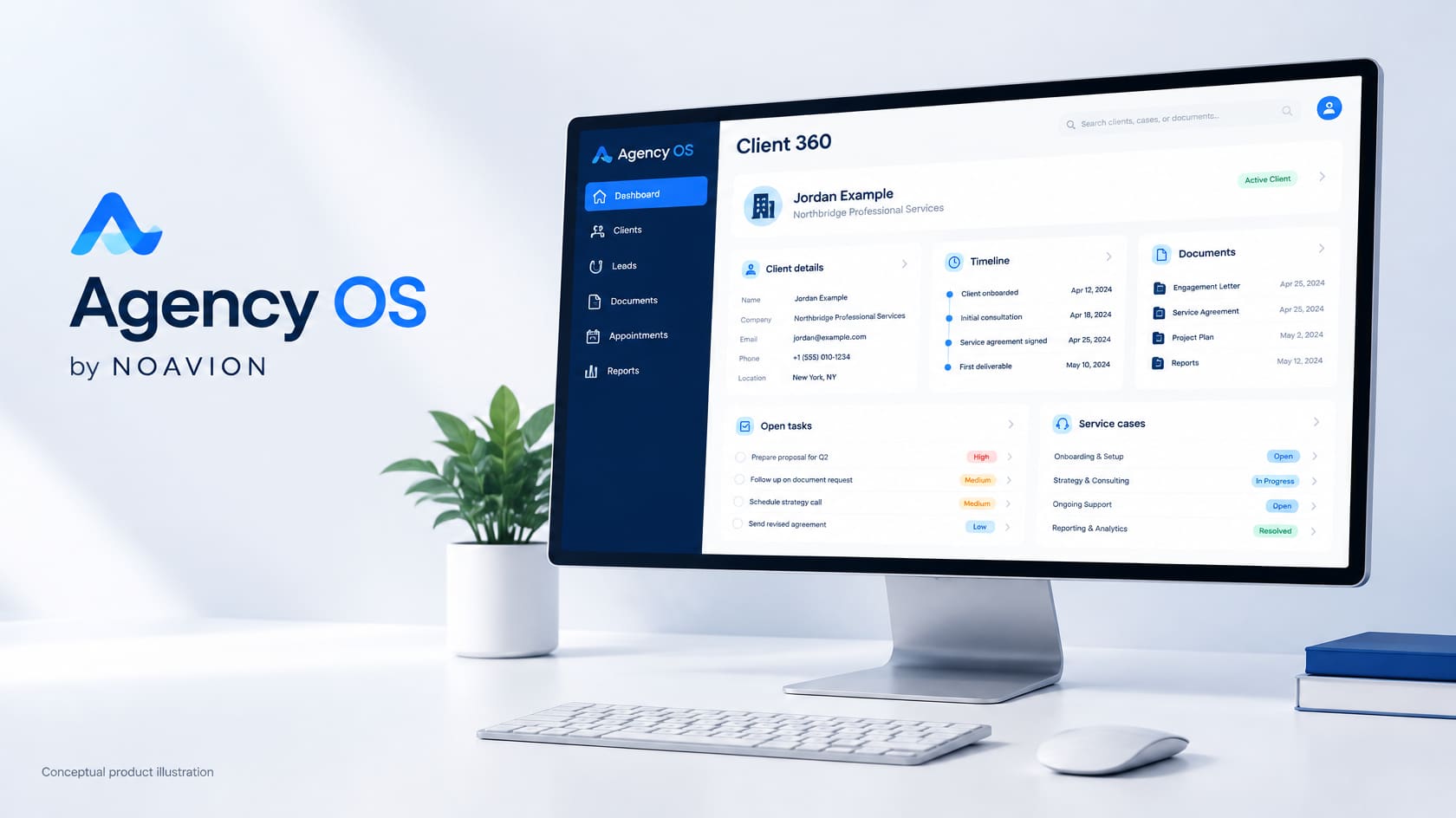
###Why a Dedicated Client Portal Matters for Service Businesses ##Clients need clarity, not another inbox When a cli...

Modern businesses have access to more technology than ever before. From customer relationship management and appointment...
Let’s build something extraordinary together.
Contact Us